
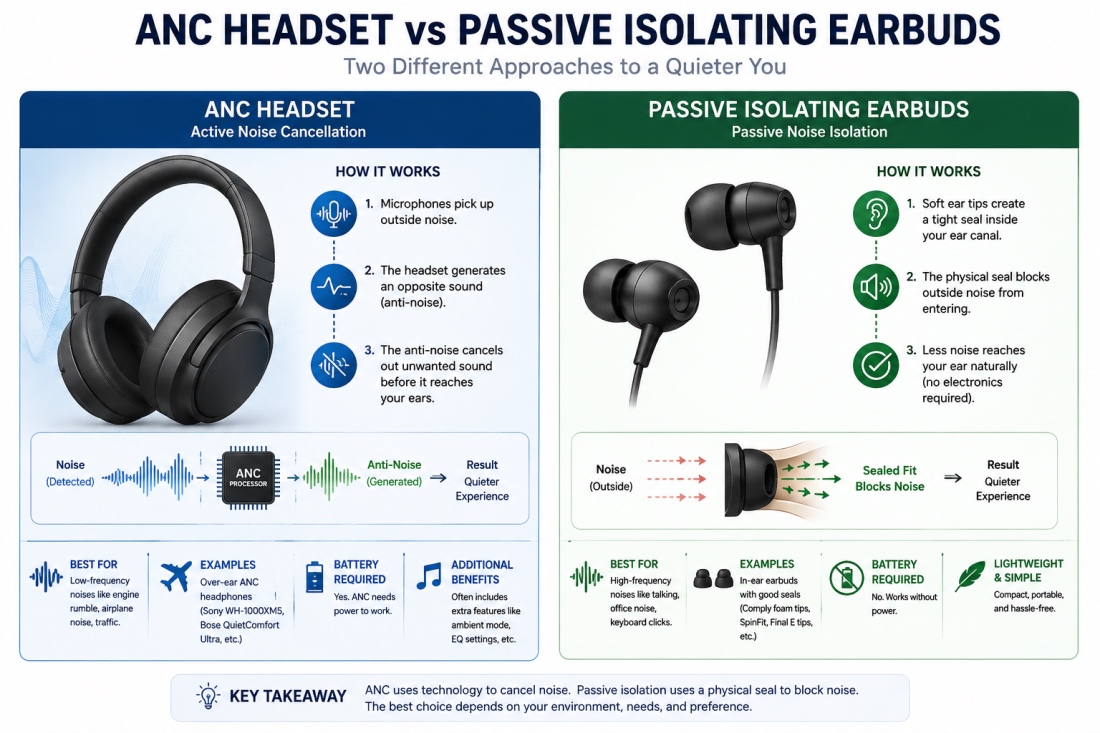
When shopping for new headphones or earbuds, choosing between active noise cancellation (ANC) and passive noise isolation is one of the most important decisions you will make. While both technologies aim to quiet the outside world, they do so in completely different ways.
Understanding how ANC vs Passive Noise Cancellation work together—or apart—can save you money and ensure you get the best audio experience for your lifestyle. Whether you are a frequent traveler trying to muffle jet engines or a student looking for focus in a busy library, this guide breaks down everything you need to know.
Quick Answer: ANC uses tiny microphones and electronic processors to generate an opposing sound wave that neutralises low-frequency background noise. Passive noise isolation relies strictly on physical barriers, like memory foam ear tips or thick ear cups, to block sound waves naturally. The right choice depends on your budget, environment, and sensitivity to noise.
At-A-Glance Comparison ANC vs Passive Noise Cancellation
| FEATURE | ACTIVE NOISE CANCELLATION (ANC) | PASSIVE NOISE ISOLATION |
| How it works | Electronics and phase inversion | Physical fit, seals, and materials |
| Best at reducing | Consistent low-frequency hums | Mid-to-high frequency sounds |
| Battery required | Yes | No |
| Works when powered off | No (functions as standard passive if engineered to) | Yes (always active physically) |
| Cost | Typically higher | Usually more affordable |
| Maintenance | Firmware updates, battery degradation care | Replacing worn ear tips or cushions |
| Best Use Cases | Airplanes, trains, loud HVAC systems | Cafes, offices, general listening |
1. What Is Active Noise Cancellation (ANC)?
Active Noise Cancellation (ANC) is an advanced electronic technology designed to reduce unwanted ambient sounds.
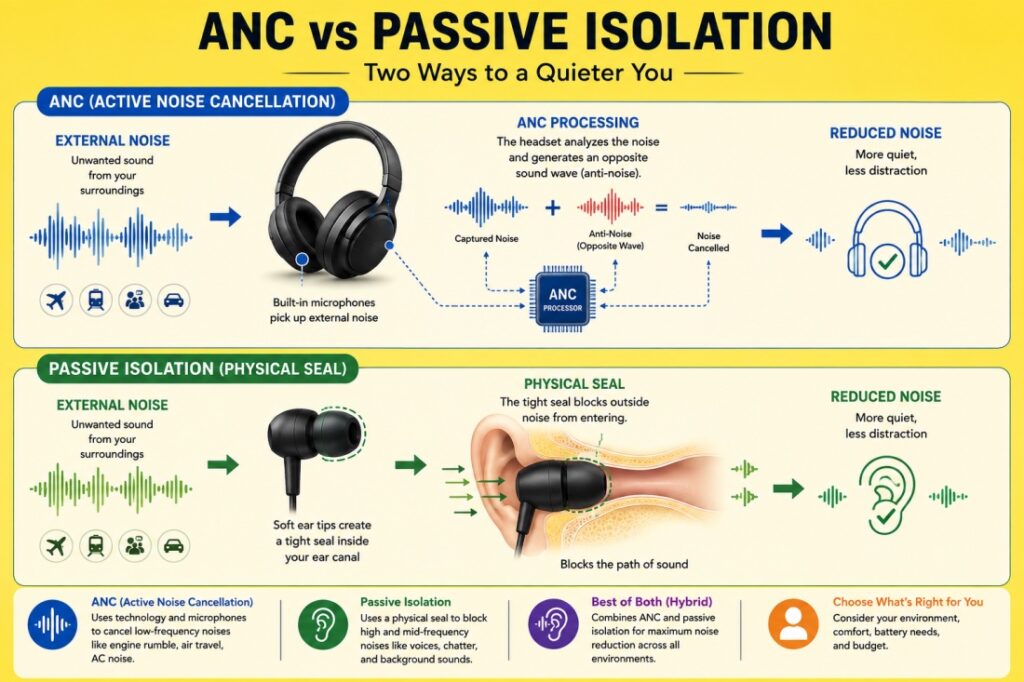
At its core, an ANC-enabled headphone or earbud uses outward-facing (and sometimes inward-facing) miniature microphones to listen to the environmental noise around you. A dedicated audio processor inside the device instantly analyzes this incoming sound wave and generates a precise inverse sound wave—often called “anti-phase audio.” When this inverted wave plays through the speaker alongside your music, it collides with the incoming noise and effectively cancels it out.
ANC excels primarily against continuous, low-frequency background sounds. Examples include:
- Airplane cabin engines and wind roar
- Train track vibrations and subway hums
- Air conditioning units and HVAC systems
- Bus engines and steady traffic drone
However, ANC does not eliminate every sound. Sudden, sharp, high-frequency noises—like a crying baby, a sharp clap, or nearby shouting—are much harder for electronic processors to predict and cancel out in real-time.
2. What Is Passive Noise Isolation?
Often marketed interchangeably as “passive noise cancellation,” passive noise isolation is technically the physical blocking of sound waves from entering your ear canal. It does not use batteries, microphones, or computer chips.
Instead, passive isolation relies entirely on acoustic engineering and physical design:
- In-ear monitors and earbuds: Use silicone or memory foam ear tips to create a tight, airtight seal inside your ear canal.
- Over-ear and on-ear headphones: Use dense memory foam padding wrapped in leather or breathable fabric, combined with a strong clamping force to create a physical barrier around your ears.
A proper physical seal stops high-frequency sounds (like speech, clattering dishes, and keyboard typing) from entering your ears in the first place.
3. ANC vs Passive Noise Cancellation: Key Differences
Comparing active vs passive noise cancellation or ANC vs Passive Noise Cancellation highlights several trade-offs in day-to-day usability:
- Technology & Method: ANC uses electronics and destructive interference; passive isolation uses physical barriers and materials.
- Battery Requirements: ANC drains battery life quickly because processors and microphones require continuous power. Passive isolation requires zero power and works indefinitely.
- Frequency Handling: ANC dominates low-frequency rumble, while passive isolation is exceptionally good at blocking high-frequency transients.
- Cost & Complexity: ANC hardware increases manufacturing costs and retail pricing, whereas passive isolation design focuses purely on ergonomics and materials.
- Reliability: Passive isolation has virtually no points of electronic failure, making rugged, non-ANC headphones exceptionally long-lasting.
4. ANC vs Passive Noise Cancellation: Which Blocks More Noise?
There is no single winner when asking which technology ANC vs Passive Noise Cancellation blocks more noise, because it depends entirely on the type of noise you face.
- For Low Frequencies: ANC is vastly superior. A physical barrier alone cannot easily stop low-frequency sound waves from traveling through solid objects and entering your head. Active electronic cancellation handles this effortlessly.
- For High Frequencies: Passive isolation often wins or matches ANC. High frequencies have short wavelengths that are easily blocked by dense foam or a proper ear tip seal. In many premium headphones, passive isolation handles the highs while ANC handles the lows, creating a powerful hybrid reduction system.
5. How Does ANC Work?
To understand how does ANC vs Passive Noise Cancellation work, it helps to look at the process step-by-step:
- Detection: Microphones mounted on the outside of the ear cup or earbud detect external environmental noise.
- Analysis: The internal digital signal processor (DSP) analyzes the frequency and amplitude of the sound wave in fractions of a millisecond.
- Inversion: The processor generates a sound wave that is the exact inverse (180 degrees out of phase) of the incoming noise.
- Playback: The headphone speaker plays this inverted wave into your ear alongside your normal audio.
- Perception: The two identical waves collide, resulting in destructive interference that drastically reduces the perceived volume of the background noise.
6. How Does Passive Noise Isolation Work?
The mechanics behind how does passive noise cancellation work are straightforward physics:
- Sound Reflection and Absorption: Dense exterior shells and thick padding reflect sound waves away from the ear, while porous foam materials absorb acoustic energy and convert it into minute amounts of heat.
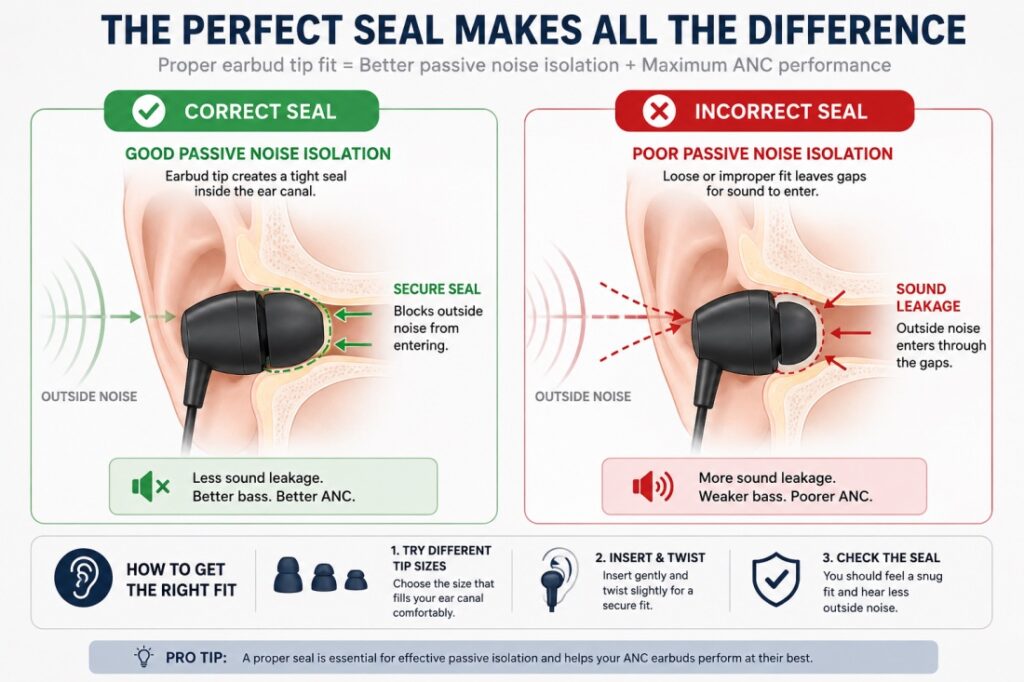
- The Seal: Sound waves travel easily through air gaps. If an earbud tip is too small or a headphone cushion does not sit flush against your head, sound leaks right in. A proper physical seal acts like a dam, drastically limiting sound transmission.
7 ANC vs Passive Noise Cancellation: Real-World Performance
| SITUATION | ANC | PASSIVE ISOLATION | BETTER CHOICE |
| Airplane | Excellent | Moderate | ANC |
| Train | Excellent | Moderate | ANC |
| Bus | Excellent | Moderate | ANC |
| Office | Good | Good | Hybrid / ANC |
| Home | Moderate | Good | Passive Isolation |
| Studying | Good | Good | Passive Isolation / ANC |
| Gym | Moderate | Good | Passive Isolation |
| Gaming | Low need | Moderate | Passive Isolation |
| Music Listening | Enhances quiet | Enhances quiet | Hybrid |
| Sleeping | Uncomfortable (bulk) | Good (soft tips) | Passive Isolation |
| Walking Outdoors | Risky (unless transparency) | Risky | Passive (with care) |
For frequent fliers, evaluating ANC vs Passive Noise Cancellation highlights why electronic phase inversion excels against constant cabin engine hums
8. ANC for Travel
Travel is where active noise cancellation truly shines. Whether you are boarding a transatlantic flight, riding an express train, or waiting in a bustling airport terminal, ANC for travel is a game-changer.
Constant engine drone induces auditory fatigue over long periods. By filtering out these low-end frequencies, ANC lets you listen to podcasts or music at much lower, safer volumes. However, travelers should always keep battery life in mind—long-haul flights require charging cases or wired backups in case your wireless batteries deplete.
9. ANC for Work and Study
In open-plan offices, busy coffee shops, or shared study spaces, distractions are everywhere. While ANC headphones vs regular headphones often spark debates in workplace settings, it is important to remember what ANC can and cannot do.
ANC will easily quiet down hums from refrigerators, air conditioners, and distant computer server racks. However, ANC does not automatically eliminate human speech. Mid-range vocal frequencies often bleed through basic ANC systems unless paired with tight passive ear seals. For office environments, a hybrid approach yields the best focus.
10. ANC for Gaming
When evaluating options for gaming, immersion is critical. While premium gaming headsets sometimes feature active noise cancellation for their microphones (to filter out room noise for your teammates), ANC for gaming earcups is less common.
Most gamers prioritize ultra-low latency, spatial audio accuracy, and lightweight comfort over heavy ANC processing circuits, which can introduce audio artifacts or drain battery during long gaming marathons.
11. ANC for Music
Audiophiles often debate whether active noise cancellation impacts sound quality. In older generations of headphones, turning on ANC could alter frequency response or introduce a slight hiss (noise floor).
Modern implementations, however, seamlessly integrate ANC without degrading music fidelity. By removing ambient background noise, ANC allows you to hear subtle details in your favorite tracks without needing to crank up the volume to dangerous levels.
Technology
Active Noise Cancellation (ANC) uses microphones to detect surrounding sounds.
It generates opposing sound waves to reduce unwanted noise.
ANC works especially well against low-frequency sounds like engines and fans.
It requires battery power and is commonly found in premium earbuds and headphones.
- Passive Noise Isolation blocks sound through physical barriers like ear tips and padding.
- It requires no battery or electronic processing to reduce noise.
Pros
Drastically reduces low-frequency background noise.
Helps lower listening fatigue during long listening sessions.
Excellent for flights, trains, and other travel environments.
Makes music, podcasts, and calls easier to hear clearly.
- No battery required, making it simple and energy-efficient.
- More affordable and highly reliable for everyday use.
- Works especially well at blocking high-frequency sounds and speech.
Cons
Requires battery power to operate effectively.
Generally costs more than passive noise-cancelling options.
May slightly alter the audio profile when poorly implemented.
Can add weight and complexity to earbuds or headphones.
Ineffective against Effectively reduces deep, constant low-frequency rumbles.
Provides strong noise isolation without electronic processing.
Its performance relies heavily on achieving a proper physical fit.
13. Which One Should You Buy?
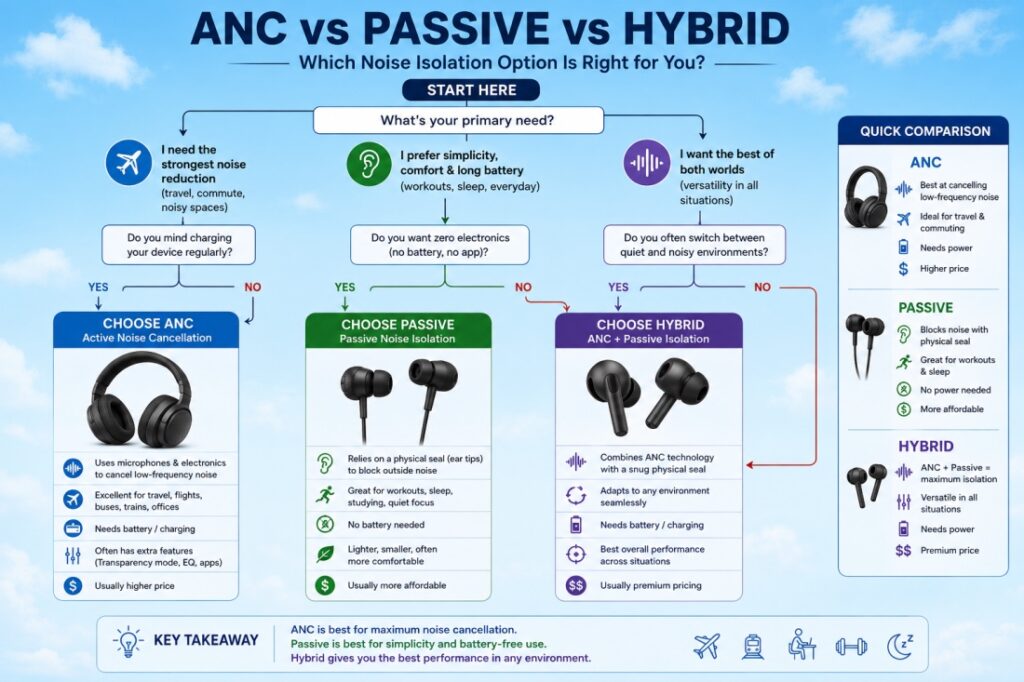
Choosing the right technology comes down to your personal habits and environments:
Deciding on ANC vs Passive Noise Cancellation ultimately comes down to your budget, preference for battery independence, and daily noise exposure
- Choose ANC if: You travel frequently, commute on public transit, work in loud environments, or want the absolute highest level of overall noise reduction available.
- Choose passive isolation if: You want maximum simplicity, hate managing battery life, operate on a tight budget, or prefer lightweight earbuds that rely purely on a comfortable, snug fit.
Note: You do not always have to choose. Many modern consumer headphones successfully combine both ANC and passive isolation, offering the ultimate versatile audio experience.
14. Is ANC Worth Paying More For?
If you are wondering are ANC headphones worth it, the answer depends heavily on your daily routine. If you spend significant time on airplanes, trains, or in noisy urban centers, paying an extra $50 to $100 for quality ANC is well worth the investment for your hearing health and comfort.
However, if you primarily listen to music at home in a quiet room or use your gear strictly while running in low-noise parks, the premium price tag for ANC offers little practical benefit.
15. Common Buying Mistakes
- Assuming ANC means complete silence: Expecting total elimination of all sounds leads to disappointment.
- Ignoring ear-tip fit: Even the best ANC earbuds fail if the silicone tip doesn’t create a proper acoustic seal.
- Buying based only on marketing claims: High marketing numbers do not guarantee real-world noise suppression quality.
- Ignoring comfort: Heavy earcups or bulky ANC processors can cause fatigue during extended listening sessions.
- Neglecting battery life: Forgetting that ANC drastically cuts down total playback time per charge.
- Ignoring transparency mode: Failing to check if the headphones offer a pass-through mode for safe outdoor walking.
- Assuming expensive equals better: High price tags do not automatically translate to superior noise isolation across all frequencies.
16 Features That Matter vs. Marketing Hype ANC vs Passive Noise Cancellation
| FEATURE / CLAIM | ACTUALLY MATTERS? | WHY? |
| Adaptive ANC | Yes | Automatically adjusts cancellation levels based on your changing environment. |
| Transparency Mode | Yes | Crucial for safety when walking outdoors or having quick conversations. |
| Huge ANC Microphone Count | No | Marketing hype; placement and software tuning matter much more than raw mic count. |
| Battery Life Specs | Yes | Directly dictates how often you must recharge with ANC toggled on. |
| App Support | Yes | Allows custom EQ settings and firmware updates to improve performance over time. |
17. How to Choose ANC Headphones or Earbuds
When narrowing down your options, follow this practical checklist:
- Assess your environment: Identify whether you deal mostly with deep rumbles (travel) or chatter (offices).
- Test the fit: Ensure multiple sizes of ear tips or comfortable headband cushions are included.
- Check battery longevity: Look for realistic battery ratings with ANC turned on.
- Evaluate transparency performance: A natural-sounding ambient mode is vital for daily wearability.
18. Budget Guide
- Budget Tier: Focus heavily on solid passive isolation. Cheap ANC implementations often introduce annoying background hisses or poor cancellation performance.
- Mid-Range Tier: Offers reliable hybrid performance, decent app support, and dependable everyday battery life.
- Premium Tier: Delivers advanced adaptive ANC, industry-leading comfort, premium materials, and flawless transparency modes.
- Best Earbuds for Travel: Top Picks for 2026
19. Long-Term Ownership Tips ANC vs Passive Noise Cancellation
- Clean silicone ear tips regularly with warm water and mild soap.
- Wipe down headphone protein-leather cushions to prevent sweat degradation.
- Store wireless earbuds in their charging case to protect internal components.
- Replace worn foam tips annually to maintain a pristine acoustic seal.
Comparison Scorecard
| CATEGORY | ANC | PASSIVE ISOLATION | WINNER |
| Low-frequency noise | Superior | Moderate | ANC |
| High-frequency noise | Equal | Equal | Tie |
| Airplane travel | Excellent | Fair | ANC |
| Office use | Excellent | Good | ANC (Hybrid) |
| Battery independence | Dependent | Independent | Passive Isolation |
| Simplicity | Moderate | High | Passive Isolation |
| Cost | Premium | Affordable | Passive Isolation |
| Versatility | High | Moderate | ANC (with passive) |
Frequently Asked Questions
What is the main difference in ANC vs Passive Noise Cancellation?
ANC uses internal microphones and digital processors to generate opposing sound waves that cancel out low-frequency noise. Passive noise cancellation uses physical barriers like memory foam, rubber tips, and dense ear cups to block sound naturally.
Is ANC better than passive noise isolation?
ANC is significantly better at blocking continuous low-frequency sounds like airplane engines. However, passive isolation is often equally effective or better at blocking high-frequency sounds like human speech and sharp clicks.
Does ANC block all noise?
No. ANC cannot block sudden, unpredictable, or high-frequency sounds like sirens, crying babies, or sharp claps. It is specifically engineered to target steady, repetitive background hums.
Does passive noise isolation work?
Yes. A proper physical seal created by well-fitted ear tips or dense over-ear cushions can block a substantial amount of high- and mid-frequency ambient noise without requiring any battery power.
Is ANC worth paying more for?
If you frequently travel, commute on noisy public transit, or work in loud environments, ANC is well worth the extra money. If you listen primarily in quiet rooms, passive isolation is usually sufficient.
Is ANC good for airplane travel?
Yes, ANC is exceptionally effective for airplane travel because it targets the steady, low-frequency engine drone that causes listening fatigue during long flights.
Does ANC work better than earplugs?
Foam earplugs often provide superior high-frequency noise blocking compared to average headphones, but they lack electronics and cannot actively cancel low-frequency rumbles the way ANC headphones can.
Does ANC use more battery?
Yes. Operating microphones and real-time digital signal processors draws continuous power, significantly reducing total battery life compared to running headphones with ANC turned off.
Can ANC damage your hearing?
No, ANC itself does not damage hearing. In fact, by lowering background noise, it often encourages listeners to keep their music at safer, lower volume levels.
Should I buy ANC earbuds or regular earbuds?
If you want versatility and live an active or traveling lifestyle, buying earbuds with ANC and strong passive isolation provides the best overall experience.
Final Verdict ANC vs Passive Noise Cancellation
- Best for Frequent Travelers: Active Noise Cancellation (ANC) provides unmatched relief from steady engine rumbles and travel fatigue.
- Best for Simplicity and Budget: Passive Noise Isolation delivers reliable, battery-free sound reduction at an accessible price point.
- Best Overall Solution: A Hybrid Approach combining high-quality ANC alongside a tight passive ear seal gives you the most versatile audio performance across all environments.
Methodology Note
How We Evaluated This Guide
This comprehensive guide is built upon established audio engineering principles, manufacturer technical documentation, independent consumer technology reviews, and expert audio analysis. No firsthand product testing claims are made. Recommendations reflect general acoustic science and real-world consumer use cases to help you make an informed buying decision.
Ultimately, understanding ANC vs Passive Noise Cancellation ensures you invest your money wisely into the audio gear that best matches your lifestyle.
Editor’s Note
Last updated: August 18, 2026
Prices, availability, specifications, and features can change. Always check the manufacturer’s or retailer’s current listing before purchasing. Recommendations are based on researched specifications and independent reviews; TechBuyGuide has not personally lab-tested every product listed.
techbuyguide1971@gmail.com