

Soundcore AeroClip Review:
Introduction
Wireless earbuds have spent most of the last decade trying to disappear inside our ears.
The Soundcore AeroClip takes the opposite approach.
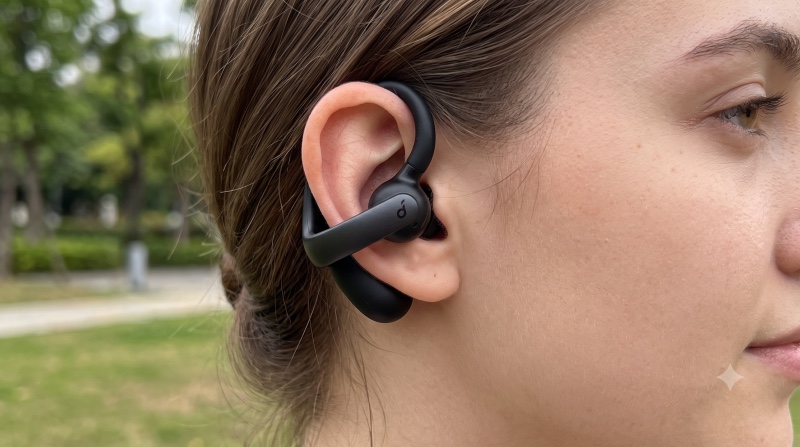
Instead of inserting a silicone tip into the ear canal, these clip-on wireless earbuds sit around the outer ear and position their speakers near the ear without creating the same sealed fit as conventional in-ear models.
That difference sounds simple, but it changes the entire purpose of the product.
Traditional earbuds are designed to create a more isolated listening environment. Open designs are built around a compromise: you hear your music while remaining more aware of the sounds around you.
That makes this category particularly interesting for walking, running, cycling, commuting, working in an office, studying and other situations where complete isolation isn’t always desirable.
The AeroClip is Soundcore’s take on that idea. The current U.S. product listing describes an adaptive open-ring clip-on design, a 12mm customized titanium-coated driver, Bluetooth 5.4, IP55 protection, four microphones with AI processing, multipoint connectivity, 8 hours of claimed earbud playback and up to 32 hours with the charging case. Soundcore currently lists the product at $169.99, although retail pricing and promotions can change.
The bigger question is whether the AeroClip is simply another interesting headphone design—or part of a genuine shift in how people want to listen.
Current market data suggests the latter. An Amazon U.S. market analysis reported about 99,360 searches for the phrase “open ear earbuds” in July 2026, while the tracked top 50 listings generated an estimated $5.9 million in sales that month. Over the preceding 12 months, those listings accounted for more than 715,000 units. This is third-party Amazon data rather than Google search data or the entire U.S. market, but it provides a useful indication of growing consumer interest.
And that brings us to the real story behind the AeroClip.
The product matters, but the technology trend behind it matters even more.
Open Ear Earbuds: What Are They?
Open-ear headphones are audio devices that allow sound to reach your ears without completely sealing the ear canal.
Unlike conventional in-ear earbuds, which use a nozzle and ear tip to sit inside the ear canal, open designs generally position a speaker near the ear.
The result is a more natural interaction between your audio and the surrounding environment.
This is sometimes described as air conduction.
How air conduction works
Air conduction is the conventional way humans hear most everyday sound.
A speaker creates vibrations in the air. Those vibrations travel through the ear canal to the eardrum, which transfers the movement through the middle and inner ear until the brain interprets it as sound.
Air conduction earbuds use this same basic pathway.
The difference is where the speaker sits.
With traditional in-ear earbuds:
Driver → sealed ear canal → eardrum
With an open-ear design:
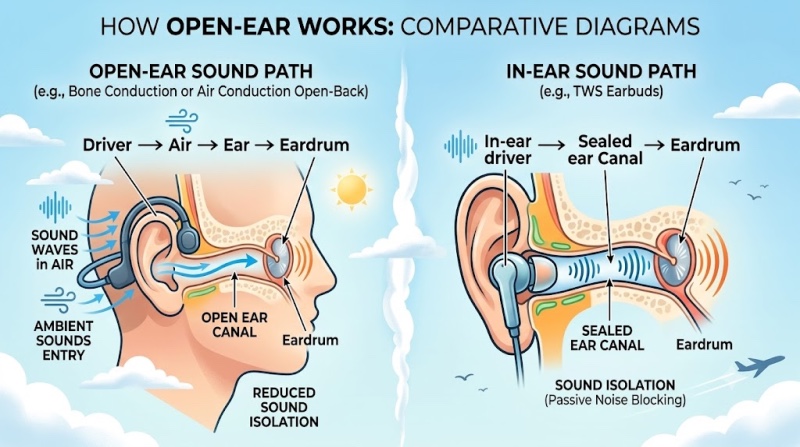
Driver → open air → ear canal → eardrum
The AeroClip belongs to the second category.
Soundcore positions its driver near the ear rather than inside the canal, allowing the ear canal to remain open.
Why does that matter?
Because the absence of a seal changes both the advantages and limitations.
You gain:
- Environmental awareness
- Less physical intrusion into the ear canal
- Potentially greater comfort for long sessions
- Easy interaction with people around you
- A different listening experience for outdoor activities
But you give up some of the natural isolation provided by a sealed earbud.
That trade-off is the foundation of the entire open-ear category.
Read more about –How to choose the best Wireless earbuds
Open Ear Earbuds vs In-Ear Earbuds
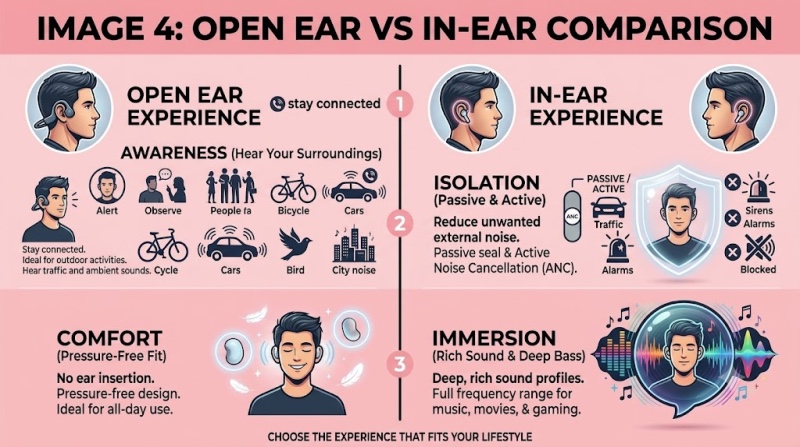
The easiest way to understand the AeroClip is to compare it with a conventional wireless earbud.
| Feature | Open-ear design | Traditional in-ear |
| Ear canal | Remains open | Partially or substantially sealed |
| Environmental awareness | High | Lower unless transparency mode is used |
| Passive isolation | Low | Moderate to high |
| ANC | Product dependent | Common |
| Common | Excellent for users who dislike tips | Highly dependent on fit |
| Bass potential | More challenging | Easier to reproduce |
| Outdoor awareness | Major advantage | Major advantage |
| Sound leakage | Sound leakage | Usually lower |
| Long listening | Strong use case | Strong use case |
| Immersion | Immersion | Usually stronger |
Neither design wins every category.
If you spend a two-hour flight trying to block engine noise, conventional ANC earbuds make more sense.
If you’re walking around your neighborhood and want to hear music while remaining aware of traffic, an open design can be more appropriate.
That is why the question “are open ear earbuds better?” doesn’t have a universal answer.
They’re better at solving certain problems.
They’re worse at solving others.
Soundcore AeroClip Design: The Clip Changes Everything
The AeroClip’s defining feature is its physical construction.
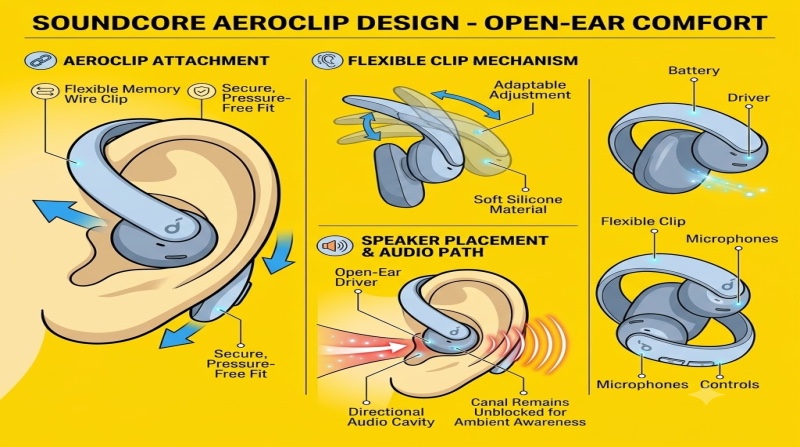
Instead of using an ear hook that wraps around the back of the ear, the AeroClip uses an adaptive open-ring structure that Soundcore says is designed for flexibility and secure positioning. The company says the structure can withstand 20,000 bends.
Each earbud weighs approximately 6 grams according to Soundcore’s current specifications.
That makes the design considerably different from both conventional earbuds and larger headphones.
The clip is not merely decorative.
It performs an important mechanical job.
Because the speaker doesn’t sit inside your ear canal, the product needs another way to keep the acoustic unit positioned correctly.
The clip holds the speaker around the ear so that it remains close to the intended listening position.
Why Open Ear Earbuds fit matters so much
With conventional earbuds, an ear tip can create a physical seal.
That seal helps with:
- Bass response
- Isolation
- Stability
- Consistent acoustic coupling
Open designs don’t have that same advantage.
The position of the speaker relative to your ear therefore becomes much more important.
Independent reviews have found the AeroClip’s fit generally comfortable and secure, although placement can sometimes require adjustment. WIRED gave the AeroClip an 8/10 rating and specifically highlighted its light, comfortable and stable fit while noting that the position can occasionally need adjustment.
That is an important distinction.
A product can be comfortable while still requiring a few seconds of adjustment to achieve the best sound balance.
Who Are Clip-On Earbuds Actually For?
The clip-on form factor is particularly attractive to people who don’t like putting anything deep into their ears.
Searches such as:
- Open Ear earbuds that clip on your ear
- ear clip headphones wireless
- ear clip earbuds
- behind ear earbuds
- earbuds that hook around ear
- outside of ear earbuds
- headphones that don’t go in ear
- earphones that don’t go inside ear
all point toward the same consumer problem: Chk out the Best Earbuds for Travel
People want personal audio without the sensation of a traditional in-ear product.
That is a real design motivation, not simply a fashion trend.
The AeroClip also illustrates another emerging direction: earbuds are becoming something people wear rather than something they simply insert.
That makes appearance, comfort and stability increasingly important.
Sound Quality: Can Open Ear Earbuds Have Good Bass?
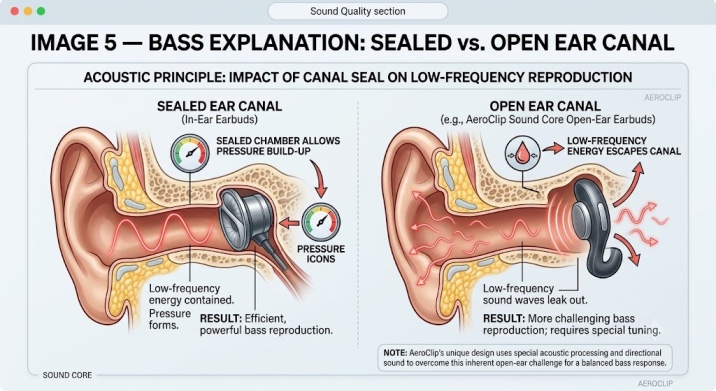
Bass is arguably the biggest technical challenge for open-ear audio.
A conventional in-ear earbud can create a seal.
That seal helps prevent low-frequency energy from escaping and provides a more controlled acoustic environment.
An open design cannot rely on that same physical advantage.
That’s why phrases such as open ear earbuds with good bass can sound contradictory at first.
They’re not.
Manufacturers can improve bass perception through larger drivers, tuning and digital processing.
Soundcore equips the AeroClip with a 12mm customized titanium-coated driver and promotes virtual bass technology as part of its sound system.
The goal is straightforward:
Make an open design sound fuller without turning it into an in-ear product.
Independent listening impressions
This is one area where independent testing is particularly valuable.
WIRED described the AeroClip as providing clear and accessible sound and noted that the product was among its more enjoyable open-ear options at the price. The review also identified bass as a fundamental limitation of open designs rather than treating the AeroClip’s performance as equivalent to a sealed high-end earbud.
TechRadar similarly found the AeroClip capable of clear, engaging audio and described its sound as a strength, while noting the absence of ANC and some sound leakage.
Tom’s Guide also praised its sound quality and EQ options, while reporting that the earbuds could sound tinny at higher volumes.
These reviews don’t establish that everyone will hear the same thing. Ear shape, fit, music preference and volume all influence perceived sound.
But they provide useful independent evidence that the AeroClip is not simply sacrificing sound quality for the open-ear concept.
What About Sound Leakage in Open Ear Earbuds?
This is one of the compromises buyers should understand before purchasing.
When the speaker isn’t enclosed by your ear canal, some sound can escape into the surrounding environment.
The amount depends on:
- Listening volume
- Speaker position
- Your ear shape
- Background noise
- The particular recording
- The product’s acoustic design
Independent reviews have identified sound leakage as a limitation of open designs, particularly when compared with conventional sealed earbuds.
This means an open earbud isn’t necessarily ideal for a silent library.
It may be comfortable for you, but someone sitting very close could potentially hear some of your music.
Open Ear Earbuds and Environmental Awareness
Environmental awareness is arguably the biggest reason to buy an open design.
Imagine walking along a sidewalk while listening to a podcast.
With sealed earbuds, you may rely on transparency mode to hear traffic, cyclists or someone speaking to you.
With open earbuds, environmental sound isn’t being blocked by a physical seal in the same way.
This is why open designs have become popular among
Runners
Walkers
Cyclists
Commuters
Office workers
Students
Travelers
People working around the house
Open does not mean “safe”
There is an important distinction here.
Being able to hear your surroundings does not make headphones inherently safe in every environment.
If you’re cycling near traffic, you still need to pay attention.
If you’re crossing a road, you still need to look.
If you’re running somewhere unfamiliar, you still need situational awareness.
Open audio can support awareness, but it shouldn’t replace it.
Open Ear Earbuds for Running, Cycling and Sports
Sports are one of the clearest applications for open-ear audio.
A runner may want music without completely disconnecting from the environment.
A cyclist may want to remain aware of traffic and other road users.
A gym user may want a podcast while still being able to hear what’s happening around them.
The clip-on form factor can also provide a different type of stability from conventional earbuds.
The AeroClip’s flexible ring is intended to keep the earbuds positioned around the ear, while the current product specification lists IP55 protection.
Independent reviews have also specifically evaluated the AeroClip for sports use. Tom’s Guide described it as a strong workout-earbud option and praised the combination of secure fit, comfort and environmental awareness.
Still, don’t confuse IP55 with waterproofing for swimming.
IP ratings describe specific laboratory-tested protection against dust and water exposure. An IP55 product isn’t designed to be submerged.
Open Ear Earbuds and Comfort
Comfort is one of the strongest arguments for this category.
People have different ear anatomy.
A conventional earbud that fits one person perfectly may feel uncomfortable for another.
Some users dislike:
- Silicone pressure
- Ear canal fullness
- Earbud movement
- Repeated insertion and removal
- The feeling of a sealed ear
- Ear fatigue during long listening sessions
This is where open designs become particularly compelling.
The AeroClip doesn’t depend on an ear-tip seal.
Soundcore specifically markets it around pressure-free listening and all-day wear.
Independent testing supports the general comfort argument. WIRED described the AeroClip as light and comfortable, while Tom’s Guide reported that the design was comfortable enough for extended use.
Of course, comfort is personal.
A clip that feels secure to one person may feel different to someone with a different ear shape.
Are Open Ear Earbuds Better for Your Ears?
This question needs careful wording.
It would be inappropriate to claim that an open-ear product is automatically “healthier” than every in-ear earbud.
The main physical difference is that open designs don’t place a sealed ear tip inside the ear canal.
That can make them feel more comfortable for some people.
But hearing health depends on factors including
Listening volume
Duration
Individual sensitivity
Existing hearing conditions
Environmental noise
An open design also shouldn’t be used as an excuse to increase volume dramatically.
In a noisy environment, users may be tempted to turn up an open earbud because external sound remains audible.
That can undermine one of the category’s supposed advantages.
So a more defensible statement is:
Open Ear Earbuds designs can be more comfortable for people who dislike in-ear pressure, but they aren’t automatically healthier at every volume or for every listener.
Air Conduction vs Bone Conduction
One of the biggest sources of confusion in this market is the relationship between open-ear and bone-conduction headphones.
They are related in their goal but different in how they deliver sound.
Air conduction earbuds
Air conduction uses a speaker to send sound through the air toward the ear.
The AeroClip is an example.
The sound ultimately enters through the outer ear and ear canal before reaching the eardrum.
Bone conduction headphones
Bone conduction works differently.
Instead of relying primarily on sound traveling through the ear canal, a transducer creates vibrations that travel through the bones of the skull toward the inner ear.
This is why traditional bone-conduction products such as the Shokz OpenRun have a very different physical design from clip-on earbuds.
They generally sit against the head rather than placing a speaker beside the ear canal.
Open Ear Earbuds vs Bone Conduction

| Technology | Sound pathway | Typical design | Main advantage |
| Open-air/air conduction | Air → ear canal | Speaker beside ear | Natural open-ear sound |
| Bone conduction | Vibration through bone | Transducer against head | Ear canal remains open |
| Over-ear | Air → ear | Cups around ear | Immersion and isolation |
This distinction is important when consumers search for phrases like:
- boneconduction headphones
- bone conduction headphones aftershokz
- Shokz bone conduction headphone
- Samsung bone conduction headphones
- onn. wireless bone conduction headphones
- hs1 bone conduction headphones
- heyday bone conduction headphones
- Shokz OpenRun bone conduction open ear headphones
- openmove wireless bone conduction headphones
Not all of these products use the same technology.
And not every product described online as “open ear” is technically a bone-conduction device.
How Does the Open Ear Earbuds AeroClip Compare With Bose, Shokz, Sony and Bowers & Wilkins?
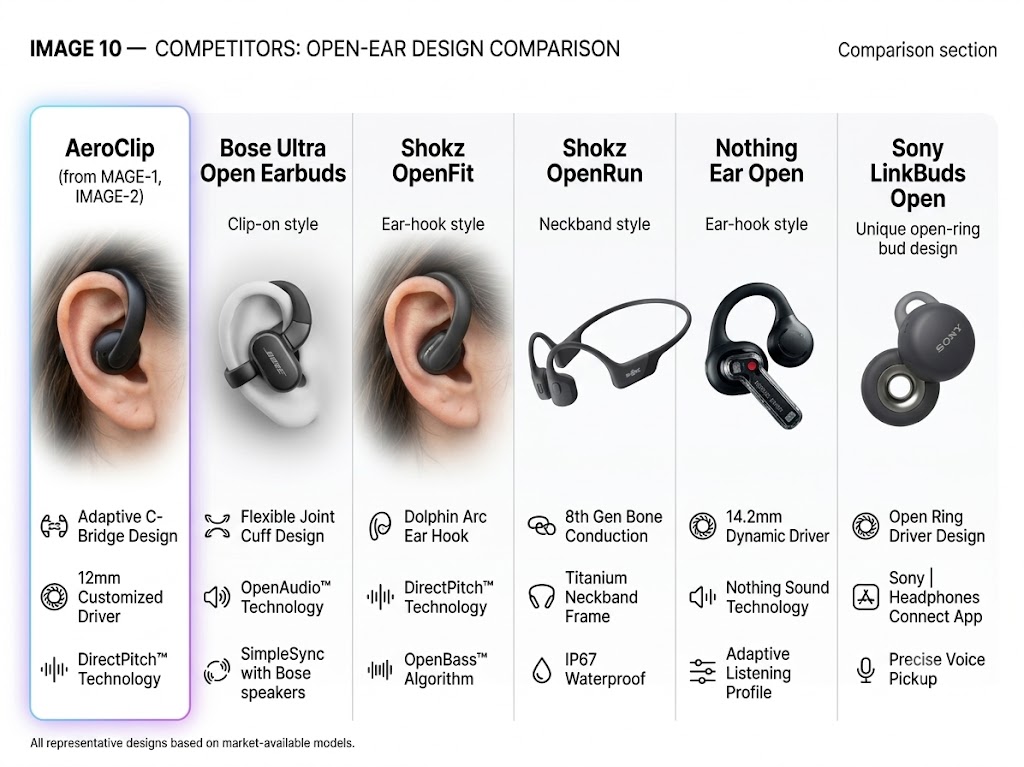
The AeroClip sits inside a much larger ecosystem.
Some of the names consumers may encounter include:
- Bose Ultra Open Earbuds
- Shokz OpenFit
- Shokz OpenRun
- Nothing Ear Open
- Sony LinkBuds Open
These aren’t interchangeable products.
Bose Ultra Open Ear Earbuds
Bose helped bring premium open-ear clip-style audio into mainstream consumer attention.
The AeroClip follows a similar broad design philosophy but targets a different price and feature balance.
Shokz OpenFit
Shokz is particularly associated with open-ear audio, although its OpenFit family uses air-conduction speaker technology rather than the bone-conduction architecture for which the company is also famous.
Shokz OpenRun
OpenRun belongs to the bone-conduction category.
It is therefore better used as a comparison point for understanding technology differences than as a direct one-to-one AeroClip competitor.
Nothing Open Ear Earbuds
Nothing’s open-ear product is another example of the industry exploring designs that don’t seal the ear canal.
Sony LinkBuds Open
Sony’s LinkBuds Open demonstrate another approach to environmental awareness and open listening.
The important lesson is that “open ear” is becoming an entire product category rather than one particular shape.
Battery Life and Charging
Battery life is another AeroClip strength on paper.
Soundcore currently rates the earbuds for:
- Up to 8 hours of playback from the earbuds
- Up to 32 hours with the charging case
- Up to 3 hours of playback from a 10-minute charge
These are manufacturer claims, not TechBuyGuide laboratory measurements. Actual battery life varies with volume, connectivity, codecs, environmental conditions and usage patterns.
For someone using the earbuds during a normal work or school day, the claimed eight-hour individual runtime is more important than the headline 32-hour figure.
The case figure matters because it reduces the need to find a charger between listening sessions.
Independent reviews have generally regarded the AeroClip’s battery life positively. WIRED described its battery as solid and reported approximately eight hours per charge and 32 hours with the case.
Bluetooth 5.4 and Multipoint
The AeroClip uses Bluetooth 5.4 and supports multipoint connectivity. Soundcore lists the ability to connect with multiple devices as one of the product’s features.
For everyday users, multipoint can be more useful than the Bluetooth version itself.
Consider a typical student or young professional:
Laptop + smartphone
You might be listening to a lecture or music on the laptop when a phone call arrives.
With multipoint, switching between connected devices can be significantly easier than disconnecting and reconnecting manually.
However, Bluetooth 5.4 by itself shouldn’t be treated as a guarantee of superior sound.
Wireless performance depends on the complete hardware and software implementation.
AI Calls: What Does AI Actually Do Here?

AI is becoming one of the most common marketing terms in modern earbuds.
The AeroClip uses four microphones with AI processing, alongside beamforming and wind-blocking mesh according to Soundcore.
The practical purpose is straightforward:
Separate your voice from unwanted environmental sound.
For example:
Your voice + traffic + wind + people talking
↓
Microphones capture the environment
↓
Signal processing identifies and emphasizes speech
↓
The other person hears a clearer voice
That is different from active noise cancellation.
ANC vs AI call processing
ANC attempts to reduce the noise you hear.
AI call processing attempts to improve the voice transmitted to the person you’re speaking with.
This distinction is particularly important because the AeroClip is an open-ear product.
The lack of traditional ANC isn’t an accidental omission.
It is partly a consequence of the product’s fundamental purpose.
What About Noise Cancellation?
Searches such as:
- open ear noise cancelling headphones
- Bose Ultra Open Earbuds noise cancelling
- Bose Ultra Open Earbuds
- open ear ANC
Reflect a genuine consumer desire:
Can I have open-ear awareness and ANC at the same time?
Some newer products are attempting exactly that.
But conventional ANC is most effective when the ear is enclosed sufficiently for the system to control the sound reaching the listener.
An open-ear design works against that physical goal.
The AeroClip therefore doesn’t provide conventional ANC. Independent reviewers have identified this as one of its main limitations.
If you need maximum noise cancellation, choose an in-ear or over-ear ANC model instead.
Soundcore AeroClip for Small Ears
Another major search behavior around earbuds involves fit.
People search for:
- AirPods for small ear canals
- ear phones for small ears
- ear buds for people with small ear canals
- smaller ear buds
- ultra small wireless earbuds
- smallest Bluetooth earbuds
- smallest earbuds wireless
- smallest earphones Bluetooth
- super small earbuds
- smallest earbuds
- world’s smallest earbud
Soundcore AeroClip for Small Ears
Another major search behavior around earbuds involves fit.
People search for:
- AirPods for small ear canals
- ear phones for small ears
- ear buds for people with small ear canals
- smaller ear buds
- ultra small wireless earbuds
- smallest Bluetooth earbuds
- smallest earbuds wireless
- smallest earphones Bluetooth
- super small earbuds
- smallest earbuds
- world’s smallest earbud
These searches mostly reflect the limitations of conventional earbud geometry.
The AeroClip takes a different approach because it doesn’t need to insert a housing into the ear canal.
That doesn’t mean it will fit every ear perfectly.
The clip still has to rest comfortably around the outer ear.
But for someone who struggles specifically with in-ear tips, the design could be worth considering.
Open Ear Earbuds: Pros and Cons
Pros
- Comfortable design for many users
- No silicone tip inserted into the ear canal
- Strong environmental awareness
- Useful for walking and outdoor activities
- Lightweight clip-on construction
- Multipoint connectivity
- Good claimed battery life
- AI-assisted call processing
- IP55 protection on the current model
- Customizable sound through the Soundcore app
- Distinctive design
Cons
- No conventional ANC
- Less isolation than sealed earbuds
- Potential sound leakage
- Bass is inherently more challenging
- Placement can affect perceived sound
- Not ideal for very noisy environments
- Sound quality at high volume can vary according to independent testing
- More expensive than many entry-level open earbuds
- Five free tickets per special exhibition
Is the Soundcore AeroClip Worth $169.99?
This is where the buying decision becomes more complicated.
Soundcore currently lists the AeroClip at $169.99 in the U.S.
However, pricing is volatile.
Independent reviews have previously encountered lower retail prices and promotions. WIRED noted that the product launched at a lower price before Soundcore raised its retail price, while Macworld reported a $169.99 review price and lower retailer pricing at the time of its review.
Therefore, the AeroClip makes more sense when evaluated against its actual street price rather than a fixed MSRP.
At a substantial discount, its combination of comfort, battery, multipoint and open-ear design becomes more attractive.
At full price, shoppers should compare it with competing open designs and premium conventional earbuds.
Is the Soundcore AeroClip Worth $169.99?
This is where the buying decision becomes more complicated.
Soundcore currently lists the AeroClip at $169.99 in the U.S.
However, pricing is volatile.
Independent reviews have previously encountered lower retail prices and promotions. WIRED noted that the product launched at a lower price before Soundcore raised its retail price, while Macworld reported a $169.99 review price and lower retailer pricing at the time of its review.
Therefore, the AeroClip makes more sense when evaluated against its actual street price rather than a fixed MSRP.
At a substantial discount, its combination of comfort, battery, multipoint and open-ear design becomes more attractive.
At full price, shoppers should compare it with competing open designs and premium conventional earbuds.
Best Open Ear Earbuds: What Should You Look For?
If you’re shopping beyond the AeroClip, don’t simply choose the model with the largest driver or biggest battery number.
Look at the following.
1. Fit
The best open-ear headphone is one that stays correctly positioned.
A poor fit can reduce both comfort and sound quality.
2. Driver placement
Because open designs don’t seal the ear, positioning is critical.
3. Bass performance
Look for independent testing rather than trusting phrases such as “deep bass.”
4. Battery
Check both per-charge and total case battery.
5. Water resistance
For sports, look for a meaningful IP rating.
6. Call quality
If calls are important, look for microphone count, beamforming and voice-processing features.
7. Multipoint
Especially useful if you move between a phone and computer.
8. Sound leakage
A good open design should minimize unnecessary leakage, although no open design should be expected to behave exactly like a sealed earbud.
Are Open Ear Earbuds the Future?
Possibly—but probably not as a complete replacement for traditional earbuds.
The more realistic future is coexistence.
A person might own:
Open earbuds
for walking, work, cycling and casual listening.
And:
ANC earbuds
for flights, trains, cafés and concentrated listening.
This two-earbud strategy makes more sense than expecting one product to solve every listening situation.
The category’s growth also suggests that consumers are becoming more willing to make that trade-off.
Amazon U.S. tracking data for July 2026 showed nearly 100,000 monthly searches for the exact “open ear earbuds” keyword and substantial sales among the leading listings. Again, this is an Amazon-specific third-party dataset rather than total U.S. market demand, but it demonstrates meaningful commercial interest.
And major technology publications are now routinely including open-ear products in their mainstream headphone recommendations. A current 2026 TechRadar guide, for example, identifies Shokz OpenFit Pro as a standout open-ear option for comfort and situational awareness.
That is a sign of category maturation.
Why Are Open Ear Earbuds Trending?
There isn’t one reason.
There are several overlapping changes in how people use personal audio.
Comfort
People increasingly wear earbuds for hours.
That makes ear-canal pressure more noticeable.
Awareness
Outdoor listening is growing, and many users don’t want to completely disconnect from their environment.
Fitness
Running, walking and cycling are natural applications for open audio.

Design
Clip-on and cuff-style designs look more like wearable accessories than traditional electronics.
Technology
Better drivers, digital processing and microphone algorithms are helping manufacturers reduce some of the weaknesses historically associated with open audio.
Lifestyle
Earbuds are increasingly used for podcasts, video calls, audiobooks and background listening rather than music alone.
The AeroClip fits directly into that shift.
There isn’t one reason.
There are several overlapping changes in how people use personal audio.
Comfort
People increasingly wear earbuds for hours.
That makes ear-canal pressure more noticeable.
Awareness
Outdoor listening is growing, and many users don’t want to completely disconnect from their environment.
Fitness
Running, walking and cycling are natural applications for open audio.
Design
Clip-on and cuff-style designs look more like wearable accessories than traditional electronics.
Technology
Better drivers, digital processing and microphone algorithms are helping manufacturers reduce some of the weaknesses historically associated with open audio.
Lifestyle
Earbuds are increasingly used for podcasts, video calls, audiobooks and background listening rather than music alone.
The AeroClip fits directly into that shift.
The Future of Open-Ear Audio Technology
The next generation of open-ear products will likely focus on making the compromise smaller.
Manufacturers have several ways to do that.
Better directional audio
If manufacturers can place sound more precisely near the ear, they can potentially improve perceived volume and reduce unnecessary leakage.
Better bass processing
Digital signal processing can compensate for some of the acoustic disadvantages of an open design.
Smarter microphones
AI-powered voice processing can improve calls in noisy environments.
Hybrid designs
The industry is already exploring products that combine open listening with additional noise-control capabilities.
Smaller hardware
As components become more efficient, open-ear products can become lighter and less noticeable.
More wearable designs
The line between headphones and accessories may continue to blur.
The AeroClip’s clip-on form is an example of this direction.
The next generation of open-ear products will likely focus on making the compromise smaller.
Manufacturers have several ways to do that.
Better directional audio
If manufacturers can place sound more precisely near the ear, they can potentially improve perceived volume and reduce unnecessary leakage.
Better bass processing
Digital signal processing can compensate for some of the acoustic disadvantages of an open design.
Smarter microphones
AI-powered voice processing can improve calls in noisy environments.
Hybrid designs
The industry is already exploring products that combine open listening with additional noise-control capabilities.
Smaller hardware
As components become more efficient, open-ear products can become lighter and less noticeable.
More wearable designs
The line between headphones and accessories may continue to blur.
The AeroClip’s clip-on form is an example of this direction.
What Are Open Ear Headphones Good For?
The simplest answer is:
Situations where you want audio without complete isolation.
They are particularly useful for:
- Walking
- Running
- Cycling
- Working from home
- Office work
- Studying
- Cooking
- Household tasks
- Podcasts
- Audiobooks
- Casual music
- Phone calls
They are less suitable for:
- Airplanes
- Loud trains
- Very noisy streets
- Heavy machinery environments
- Situations requiring maximum bass
- Critical listening where isolation matters
Frequently Asked Questions
What are open ear earbuds?
They are wireless earbuds that play sound without creating the same sealed connection inside the ear canal as traditional in-ear earbuds.
What is an open earbud?
An open earbud is an audio device that positions its speaker near the ear while leaving the ear canal relatively unobstructed.
Are open earbuds good?
They can be excellent if comfort and environmental awareness are your priorities. They are less suitable if your priority is maximum isolation or ANC.
Are open earbuds better for your ears?
They can feel more comfortable for people who dislike in-ear pressure, but they should not automatically be described as healthier. Listening volume and duration remain important.
Are open ear headphones better than traditional headphones?
It depends on the use case. Open designs prioritize awareness and comfort, while traditional headphones generally provide better isolation and immersion.
How do open ear headphones work?
Most open-ear earbuds use air conduction. A small speaker sends sound through the air toward the ear rather than sealing the ear canal.
What is air conduction?
Air conduction is the normal hearing pathway in which sound travels through the air into the ear canal, moves the eardrum and ultimately stimulates the auditory system.
Are air conduction earbuds the same as bone conduction headphones?
No. Air conduction uses a speaker to send sound through the air. Bone conduction uses vibrations transmitted through bone toward the inner ear.
Open ear earbuds vs bone conduction: which is better?
Neither is universally better. Air-conduction open earbuds generally provide a more conventional speaker-based listening experience, while bone conduction keeps the ear canal open through a different sound-transmission method.
How do you wear bone conduction headphones?
Most bone-conduction sports headphones sit outside the ear with transducers positioned against the bones near the ears. Always follow the manufacturer’s fit instructions.
How does Shokz headphones work?
Shokz sells different technologies, including bone-conduction and air-conduction products. Bone-conduction models transmit vibrations through the bones toward the inner ear rather than relying on an ear-canal seal.
Are open ear earbuds good for running?
They can be a strong option because they allow environmental sounds to remain audible. The AeroClip’s clip-on design and current IP55 rating also make it relevant to outdoor use.
Are open ear earbuds good for cycling?
They can help maintain awareness of environmental sound, but cyclists should never depend on headphones alone for road safety.
What are earbuds that sit outside the ear?
This is another common description of open-ear earbuds. Instead of placing the main acoustic housing inside the ear canal, they position the speaker near the outer ear.
What are earbuds that don’t go in your ears?
Usually this refers to open-ear earbuds, air-conduction earbuds or bone-conduction headphones, depending on the product.
What are earbuds that don’t go in your ear canal?
Open-ear earbuds are designed specifically around this concept.
What are outside-of-ear earbuds?
They are generally open-ear products in which the speaker rests outside or beside the ear canal.
What are earbuds that clip on your ear?
They are clip-on open-ear earbuds. The AeroClip is an example.
What are ear hook open ear earbuds?
These use a hook that wraps around the ear to hold an open-ear speaker in position.
What are cuff-style open earbuds?
They use a jewelry-inspired or clip-like structure around the ear instead of a conventional in-ear tip.
What are behind ear earbuds?
This usually refers to earbuds or headphones that use a structure around the back of the ear for stability.
What are wraparound headphones?
Wraparound headphones use a band or structure that travels around the head or ear to maintain stability.
What are the smallest earbuds?
There isn’t one universally accepted “smallest earbud.” Size varies by component configuration, battery capacity and design.
Are AirPods 4 open ear?
AirPods 4 have an open-style fit compared with Apple’s in-ear AirPods Pro models, but they are not the same physical design as clip-on open-ear earbuds such as the AeroClip.
Are AirPods open ear?
Some AirPods models use a non-sealing design, but “AirPods” covers multiple generations and designs. Check the specific model rather than treating all AirPods as identical.
What are AirPods 4 open ear specs in 2026?
Specifications depend on the exact AirPods 4 version. Buyers should check Apple’s current product specifications rather than relying on generic “open ear AirPods” terminology.
How much are earbuds?
Prices range from inexpensive budget models to premium products costing several hundred dollars. The AeroClip is currently listed by Soundcore at $169.99 in the U.S.
How do I choose wireless earbuds?
Start with your use case. Decide whether you prioritize ANC, comfort, environmental awareness, sound quality, battery life, calls, fitness or device compatibility.
What should I look for when buying wireless earbuds?
Consider fit, sound, battery life, water resistance, microphone performance, connectivity, controls, app support and the return policy.
What are quality earbuds wireless buyers should consider?
Look beyond specifications. Independent sound measurements, comfort testing, microphone quality and reliability can be more informative than driver size or Bluetooth version alone.
What are reliable earbuds?
Reliability depends on hardware quality, battery longevity, software support, warranty and after-sales service. No single brand is automatically reliable for every product.
Are open ear earbuds better than in-ear earbuds?
They’re better for environmental awareness and can be more comfortable for people who dislike ear-canal pressure. In-ear models remain better for isolation, ANC and often bass.
Open ear vs in ear earbuds: which should I buy?
Choose open ear if you want awareness and a non-intrusive fit. Choose in-ear if you want isolation, ANC and a more immersive listening experience.
Are open ear headphones better?
They’re better for certain situations, not universally.
Are open earbuds better?
Again, it depends on what you value. Their major strengths are awareness and comfort rather than isolation.
Can open ear earbuds have noise cancellation?
Some newer products experiment with noise-control technologies, but traditional ANC works most naturally with designs that can form a more controlled acoustic seal.
Do open earbuds leak sound?
Yes, they can. Leakage varies according to volume, product design, fit and environment.
What is the difference between open ear and bone conduction?
Open-ear air-conduction products use speakers positioned near the ear. Bone-conduction headphones use vibrations transmitted through the skull toward the inner ear.
Frequently Asked Questions
What are open ear earbuds?
They are wireless earbuds that play sound without creating the same sealed connection inside the ear canal as traditional in-ear earbuds.
What is an open earbud?
An open earbud is an audio device that positions its speaker near the ear while leaving the ear canal relatively unobstructed.
Are open earbuds good?
They can be excellent if comfort and environmental awareness are your priorities. They are less suitable if your priority is maximum isolation or ANC.
Are open earbuds better for your ears?
They can feel more comfortable for people who dislike in-ear pressure, but they should not automatically be described as healthier. Listening volume and duration remain important.
Are open ear headphones better than traditional headphones?
It depends on the use case. Open designs prioritize awareness and comfort, while traditional headphones generally provide better isolation and immersion.
How do open ear headphones work?
Most open-ear earbuds use air conduction. A small speaker sends sound through the air toward the ear rather than sealing the ear canal.
What is air conduction?
Air conduction is the normal hearing pathway in which sound travels through the air into the ear canal, moves the eardrum and ultimately stimulates the auditory system.
Are air conduction earbuds the same as bone conduction headphones?
No. Air conduction uses a speaker to send sound through the air. Bone conduction uses vibrations transmitted through bone toward the inner ear.
Open ear earbuds vs bone conduction: which is better?
Neither is universally better. Air-conduction open earbuds generally provide a more conventional speaker-based listening experience, while bone conduction keeps the ear canal open through a different sound-transmission method.
How do you wear bone conduction headphones?
Most bone-conduction sports headphones sit outside the ear with transducers positioned against the bones near the ears. Always follow the manufacturer’s fit instructions.
How does Shokz headphones work?
Shokz sells different technologies, including bone-conduction and air-conduction products. Bone-conduction models transmit vibrations through the bones toward the inner ear rather than relying on an ear-canal seal.
Are open ear earbuds good for running?
They can be a strong option because they allow environmental sounds to remain audible. The AeroClip’s clip-on design and current IP55 rating also make it relevant to outdoor use.
Are open ear earbuds good for cycling?
They can help maintain awareness of environmental sound, but cyclists should never depend on headphones alone for road safety.
What are earbuds that sit outside the ear?
This is another common description of open-ear earbuds. Instead of placing the main acoustic housing inside the ear canal, they position the speaker near the outer ear.
What are earbuds that don’t go in your ears?
Usually this refers to open-ear earbuds, air-conduction earbuds or bone-conduction headphones, depending on the product.
What are earbuds that don’t go in your ear canal?
Open-ear earbuds are designed specifically around this concept.
What are outside-of-ear earbuds?
They are generally open-ear products in which the speaker rests outside or beside the ear canal.
What are earbuds that clip on your ear?
They are clip-on open-ear earbuds. The AeroClip is an example.
What are ear hook open ear earbuds?
These use a hook that wraps around the ear to hold an open-ear speaker in position.
What are cuff-style open earbuds?
They use a jewelry-inspired or clip-like structure around the ear instead of a conventional in-ear tip.
What are behind ear earbuds?
This usually refers to earbuds or headphones that use a structure around the back of the ear for stability.
What are wraparound headphones?
Wraparound headphones use a band or structure that travels around the head or ear to maintain stability.
What are the smallest earbuds?
There isn’t one universally accepted “smallest earbud.” Size varies by component configuration, battery capacity and design.
Are AirPods 4 open ear?
AirPods 4 have an open-style fit compared with Apple’s in-ear AirPods Pro models, but they are not the same physical design as clip-on open-ear earbuds such as the AeroClip.
Are AirPods open ear?
Some AirPods models use a non-sealing design, but “AirPods” covers multiple generations and designs. Check the specific model rather than treating all AirPods as identical.
What are AirPods 4 open ear specs in 2026?
Specifications depend on the exact AirPods 4 version. Buyers should check Apple’s current product specifications rather than relying on generic “open ear AirPods” terminology.
How much are earbuds?
Prices range from inexpensive budget models to premium products costing several hundred dollars. The AeroClip is currently listed by Soundcore at $169.99 in the U.S.
How do I choose wireless earbuds?
Start with your use case. Decide whether you prioritize ANC, comfort, environmental awareness, sound quality, battery life, calls, fitness or device compatibility.
What should I look for when buying wireless earbuds?
Consider fit, sound, battery life, water resistance, microphone performance, connectivity, controls, app support and the return policy.
What are quality earbuds wireless buyers should consider?
Look beyond specifications. Independent sound measurements, comfort testing, microphone quality and reliability can be more informative than driver size or Bluetooth version alone.
What are reliable earbuds?
Reliability depends on hardware quality, battery longevity, software support, warranty and after-sales service. No single brand is automatically reliable for every product.
Are open ear earbuds better than in-ear earbuds?
They’re better for environmental awareness and can be more comfortable for people who dislike ear-canal pressure. In-ear models remain better for isolation, ANC and often bass.
Open ear vs in ear earbuds: which should I buy?
Choose open ear if you want awareness and a non-intrusive fit. Choose in-ear if you want isolation, ANC and a more immersive listening experience.
Are open ear headphones better?
They’re better for certain situations, not universally.
Are open earbuds better?
Again, it depends on what you value. Their major strengths are awareness and comfort rather than isolation.
Can open ear earbuds have noise cancellation?
Some newer products experiment with noise-control technologies, but traditional ANC works most naturally with designs that can form a more controlled acoustic seal.
Do open earbuds leak sound?
Yes, they can. Leakage varies according to volume, product design, fit and environment.
What is the difference between open ear and bone conduction?
Open-ear air-conduction products use speakers positioned near the ear. Bone-conduction headphones use vibrations transmitted through the skull toward the inner ear.
Who Should Buy the Soundcore AeroClip?
The AeroClip makes the most sense for someone who says:
“I want headphones, but I don’t want something inside my ear.”
It is particularly compelling if you:
- Listen for several hours a day
- Dislike silicone ear tips
- Walk or run outdoors
- Work in an environment where you need awareness
- Take frequent calls
- Switch between phone and laptop
- Want a lightweight design
- Prefer podcasts and casual music
- Want open listening without moving to a full-size headphone
The AeroClip’s current specification sheet gives it a strong feature set: 12mm titanium-coated drivers, Bluetooth 5.4, multipoint, IP55, four-microphone AI calling and up to 32 hours of total battery life.
Independent reviews also generally support the product’s core strengths in comfort, sound and usability. WIRED rated it 8/10, while TechRadar and Tom’s Guide similarly highlighted comfort and sound as major strengths.
The AeroClip makes the most sense for someone who says:
“I want headphones, but I don’t want something inside my ear.”
It is particularly compelling if you:
- Listen for several hours a day
- Dislike silicone ear tips
- Walk or run outdoors
- Work in an environment where you need awareness
- Take frequent calls
- Switch between phone and laptop
- Want a lightweight design
- Prefer podcasts and casual music
- Want open listening without moving to a full-size headphone
The AeroClip’s current specification sheet gives it a strong feature set: 12mm titanium-coated drivers, Bluetooth 5.4, multipoint, IP55, four-microphone AI calling and up to 32 hours of total battery life.
Independent reviews also generally support the product’s core strengths in comfort, sound and usability. WIRED rated it 8/10, while TechRadar and Tom’s Guide similarly highlighted comfort and sound as major strengths.
Who Should Avoid the AeroClip?
Don’t buy it simply because open-ear audio is fashionable.
Avoid it if your priorities are:
Maximum ANC
Look at conventional ANC earbuds instead.
Maximum bass
A sealed in-ear design is likely to give you a stronger low-frequency experience.
Complete privacy
Open designs can leak more sound.
Airplane travel
An open design allows too much external sound into the listening experience for many travelers.
Audiophile isolation
If you want the most controlled acoustic environment possible, an open-ear clip isn’t the obvious choice.
Don’t buy it simply because open-ear audio is fashionable.
Avoid it if your priorities are:
Maximum ANC
Look at conventional ANC earbuds instead.
Maximum bass
A sealed in-ear design is likely to give you a stronger low-frequency experience.
Complete privacy
Open designs can leak more sound.
Airplane travel
An open design allows too much external sound into the listening experience for many travelers.
Audiophile isolation
If you want the most controlled acoustic environment possible, an open-ear clip isn’t the obvious choice.
TechBuyGuide Verdict
The Soundcore AeroClip is best understood not as a replacement for every wireless earbud, but as a solution to a different problem.
Its biggest advantage isn’t Bluetooth 5.4.
It isn’t even the 12mm driver.
It’s the decision to leave the ear canal open.
That makes the AeroClip fundamentally different from the traditional wireless-earbud formula.
For users who want comfort, awareness and long listening sessions, the design makes considerable sense. Soundcore has also added useful everyday features such as multipoint connectivity, customizable sound, AI-assisted calling and a long claimed battery life.
The compromises are equally clear.
There is no traditional ANC. Sound leakage is possible. Bass reproduction remains more difficult than with sealed in-ear earbuds. And independent testing suggests that high-volume listening can expose some of the acoustic limitations of the design.
So the right question isn’t:
“Is the AeroClip better than AirPods or Bose?”
The better question is:
“Is an open-ear design the right type of headphone for the way I listen?”
For runners, walkers, commuters, office workers, students and people who dislike in-ear tips, the answer may be yes.
For frequent flyers, bass-focused listeners and people who want strong ANC, the answer is probably no.
Conclusion: Why the AeroClip Matters
The Soundcore AeroClip arrives during a broader change in personal audio.
For years, the industry treated isolation as the ultimate goal.
More isolation.
More ANC.
More bass.
More immersion.
Open-ear audio challenges that assumption.
Sometimes people don’t want the world to disappear.
They want music and the world.
That’s the central idea behind the AeroClip.
Its clip-on architecture, open acoustic approach, AI-assisted calls, multipoint connectivity, claimed 8-hour battery life and current IP55 rating make it a strong example of where this part of the headphone market is heading.
The growing commercial interest also suggests that open-ear products are no longer a niche curiosity. Third-party Amazon U.S. data recorded nearly 100,000 searches for the category’s main keyword in July 2026, with substantial sales among leading products.
But the most important trend isn’t simply that people are buying another kind of earbud.
It’s that consumers are becoming more specific about how they want technology to fit into their lives.
Some want isolation.
Some want awareness.
Some want maximum bass.
Some want comfort.
And increasingly, people want an earbud that doesn’t feel like an earbud at all.
That’s where the AeroClip makes its strongest argument.
TechBuyGuide’s recommendation: Consider the Soundcore AeroClip if comfort, environmental awareness and all-day usability matter more to you than ANC and maximum isolation. If those priorities are reversed, a high-quality conventional ANC earbud remains the better choice.
Methodology Note
How We Evaluated This Guide
This comprehensive guide is built upon established audio engineering principles, manufacturer technical documentation, independent consumer technology reviews, and expert audio analysis. No firsthand product testing claims are made. Recommendations reflect general acoustic science and real-world consumer use cases to help you make an informed buying decision.
Editor’s Note
Last updated: Sept 03 , 2026
Prices, availability, specifications, and features can change. Always check the manufacturer’s or retailer’s current listing before purchasing. Recommendations are based on researched specifications and independent reviews; TechBuyGuide has not personally lab-tested every product listed.
techbuyguide@hotmail.com